Silent Bricks • VTL • Secondary Storage • Made in Europe
Replace your tape library Without changing a single workflow.
Tape archives will eventually need to migrate to S3. HSMs are becoming obsolete, archiving software increasingly requires S3, and AI needs direct access to data. The Silent Brick System offers a way to achieve this without a complete overhaul: the archive continues to run as normal. New workloads and AI access are added gradually to S3 volumes, on the same hardware.
The problem
Why large tape archives are reaching their limits
No random access: Tape is sequential. Restoring a single file from a 50-TB archive requires rewinding entire tapes. As archive sizes grow, access times become unacceptably long.
Not AI-ready: Archive data is required for ML pipelines and RAG systems. Tape cannot provide random, parallel access, a structural problem that hardware cannot solve.
High operational costs: Tapes must be inventoried, labelled, transported and checked for readability. With 100 or more tapes, this is a labour-intensive process that offers no strategic added value.
Technology risk: LTO drives are produced by only a handful of manufacturers. The roadmap, driver compatibility and supply of spare parts are controlled externally — the archive is subject to an uncontrolled dependency.
HSM compatibility issue: Many HSMs no longer run reliably on current OS versions. Attempts to replace the HSM are thwarted by the fact that a tape library is connected to it — both must be migrated at the same time.
The solution
Silent Bricks as VTL
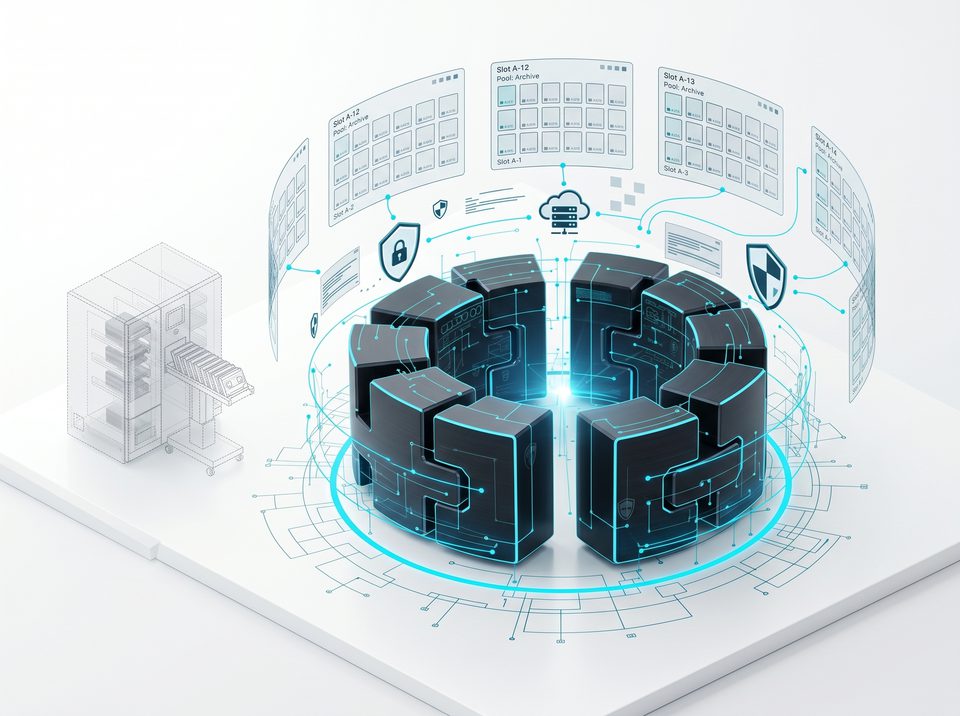
The Silent Brick System emulates a tape library at the protocol level. Your archiving or backup software sees a VTL endpoint and behaves exactly as it would with a physical library. Behind the scenes, there are no tapes, but rather high-performance Silent Bricks.
No big bang
HSM stays, the software stays, retention policies stay. Only the medium changes: from tape to Silent Brick.
Random access instead of cueing
Restore directly to the target data block — no cueing. Restores in minutes rather than hours, even from deep archive layers.
Comparable energy consumption
Silent Brick Max Air has energy consumption comparable to that of a tape library in standby mode — designed for long-term archiving.
A step-by-step guide to S3
In parallel: S3/NFS volumes for new archive sections or AI workloads on the same hardware — without migrating existing data.
CARE SLA up to 10 years
Maintenance contracts covering spare parts and support at fixed rates — no dependence on the LTO roadmap or component availability.
Replacing tape archive with Silent Bricks as VTL
Four steps, no big bang, no downtime.
Integration as a VTL
Archiving as before
Random access
Step by step to S3
Migration path
The path to S3. Without the Big Bang.
Phase 1
VTL Integration
Silent Bricks as a drop-in replacement for tape libraries. HSM and archiving software remain unchanged. Immediate benefits: random access, no media changes, no operational overhead.
Phase 2
Concurrent access
Write new archive segments directly to S3 volumes. AI workloads, ML pipelines and RAG systems utilise the same hardware via S3/NFS. Existing VTL data remains untouched.
Phase 3
Step-by-step migration
Migrate older tape archives once retention periods have expired or during system migrations. No time pressure, no risk — the legacy data continues to run.
Silent Bricks VTL x physische Tape Library
| Criteria | Silent Bricks (VTL) | Tape Library (LTO) |
|---|---|---|
| Workflow change | None | None |
| Restore performance | Random Access | Sequential |
| AI/Analytics access | ✓ via a separate S3 volume | ⛌ structurally impossible |
| Operating expenses | Gring (no media changes) | High (tapes, rotation, robotics) |
| Power consumption (idle state) | Low (comparable) | Low |
| Supply reliability | ✓ Made in Europe | A few manufacturers (US/Asia) |
| Cost-effective SLA in the long term | ✓ Up to 10 years with CARE | Questionable |
| Air Gap | ✓ Electrolytic, automated | Manual / semi-automatic |
Frequently asked questions
Not usually. The controller emulates a standard tape library. The software recognises a familiar VTL endpoint; there is no need to reconfigure media labels, retention policies or library slots.
Yes. Silent Bricks can be operated as an additional VTL target alongside existing tape infrastructure, enabling a phased migration without any downtime.
We recommend a phased migration: Silent Bricks takes over new backup and archiving jobs, whilst older tape archives are migrated as required or remain on tape until the end of their retention period. FAST LTA provides support with migration planning.
Silent Bricks are designed for long-term operation. CARE maintenance contracts guarantee support and spare parts for up to 10 years on fixed terms. No price risk, no technology migration during the contract period.
Tape restores from large archives require tapes to be rewound, which can take several hours depending on the depth of the archive. Silent Bricks in VTL mode provide random access for restore purposes: the controller accesses the required data block directly, without the need for sequential scanning. S3/NFS volumes are required for direct AI access to archive data (ML frameworks, RAG systems); VTL volumes are tape emulations without a corresponding interface and without random access.
Next step
A risk-free migration path
The tape archive continues to run, with S3 workloads being added gradually — on the same hardware, without the need for parallel infrastructure, and without data migration on day one. For existing tape and HSM environments, we recommend a 45-minute technical consultation.