Artikel | 22. May 2026
AI Knowledge Management
How to make the most of your internal knowledge
Generative AI has spread through organizations faster than the structures meant to govern its use. Cloud AI services deliver impressive answers to general questions, but they fall short on the discipline that matters most: working reliably with an organization's own knowledge: contracts, studies, case files, design data, and standard operating procedures. That body of knowledge is at once the most valuable and the most sensitive.
AI knowledge management is the discipline that closes this gap. It connects language models to an organization's own data so that staff get precise answers from internal sources, with source citations, with permissions respected, and without data leaving the organization.
This guide shows IT leaders, AI owners, and operations executives what AI knowledge management means in technical and organizational terms: which architectural approaches hold up, which sources to open up, why access control is the most underestimated topic, and what a productive, sovereign system looks like.
Reading time: approx. 16 minutes | Last updated: May 2026
- 1. What is AI knowledge management?
- 2. Drei Treiber: Warum jetzt
- 3. Three routes to local AI compared
- 4. Understanding RAG architecture
- 5. Connector strategy: which sources, in what order
- 6. Access control: the overlooked topic
- 7. Reference architecture for sovereign AI knowledge management
- 8. Measuring success and ROI
- 9. 90-day action plan
- 10. Frequently asked questions
1. What is AI knowledge management? #
AI knowledge management is the use of generative AI to make an organization’s internal knowledge retrievable and productively usable for staff. Three properties separate it from casual AI use:
Grounding in your own data. Answers are based not on the language model’s general training knowledge, but on specific documents from the organization: contracts, reports, wikis, and files. The model does the phrasing; the sources supply the content.
Source citation. Every answer points to the original documents it came from. Staff can trace where a piece of information originated and verify it against the source text.
Respect for permissions. The AI answers only on the basis of content the asking user is authorized to access. Personnel files, M&A documents, and NDA material stay invisible to unauthorized users, even when they are technically indexed.
This makes AI knowledge management much more than a chatbot. It is an information infrastructure that joins search, language understanding, and access logic into a single system.
2. Three drivers: why now #
AI knowledge management is not a new term, but the urgency of getting it done has risen sharply in 2026. Three drivers work together.
Competitive pressure. Organizations that use AI productively cut research, drafting, and decision times considerably. A study by the Federal Reserve Bank of St. Louis (Bick, Blandin, Deming; survey November 2024) finds an average time saving of roughly 5.4% of the working week among regular users of generative AI. McKinsey cites this figure in “Superagency in the Workplace” (2025). An organization that fails to provide a vetted AI solution forfeits this productivity edge, or accepts that staff will create it themselves through shadow AI.
Compliance lock-in. The EU AI Act, NIS2, and create a situation in which cloud AI for regulated data is effectively ruled out. At the same time, Article 4 of the EU AI Act (the AI literacy obligation, applicable since February 2025) and the ’s record-of-processing requirements force organizations to disclose and govern their AI use. An official, vetted internal solution is the only clean answer.
Implementation gap. According to McKinsey, 88% of organizations have adopted AI in at least one function, but only a fraction reach measurable business results: just 39% report EBIT impact at the enterprise level. BCG found that around 60% of companies derive no material value from their AI investments so far. The reason is rarely the model; it is the connection to the organization’s own data and processes. Building AI knowledge management systematically closes that gap.
GDPR
The GDPR (General Data Protection Regulation, EU 2016/679) is the European regulation for the protection of personal data — particularly relevant for IT infrastructure in Art. 5 (principles), Art. 17 (right to erasure), Art. 28 (processors) and Art. 32 (security of processing).
DORA
DORA (Digital Operational Resilience Act, EU 2022/2554) is an EU regulation that has applied to all regulated financial market participants since January 2025, setting concrete requirements for ICT risk management, backup systems (Art. 11 and 12), third-party provider management (Art. 28–30) and incident reporting.
Data Sovereignty
Data sovereignty describes an organization's complete control over its data: where it is stored, who can access it, which legal framework applies to it and whether it is available at any time without dependency on a single provider.
3. Three routes to local AI compared #
If you want to rule out cloud AI for sensitive data, you have three technical options. They differ fundamentally in effort, maintenance, future-readiness, and in whether the approach is even viable for a mid-sized organization.
3.1 Train your own LLM #
A language model of your own, built on public or proprietary training data. Maximum specialization, full control. In practice this is feasible only for large corporations with a dedicated AI research function.
Effort: A multi-million investment in hardware, power, training data, and an ML team. Training runs take weeks to months.
Risk: The model ages quickly. Open-source models (Mistral, Llama, Qwen, Gemma) advance every quarter; a self-trained model falls behind within a few months.
Suited to: Research institutions and large corporations with their own AI strategy and a multi-year horizon.
3.2 DIY with local LLMs #
Open-source tools such as Ollama, LM Studio, or llama.cpp on your own GPU hardware. You build the RAG pipeline and the connectors yourself. Low barrier to entry, high flexibility for developers.
Effort: A small initial hardware investment. But connectors, access control, vector database, audit trail, and model updates all have to be implemented and maintained in house.
Risk: It does not scale beyond the prototype. Once you have to connect several sources, permission models, and user groups, the maintenance burden becomes prohibitive. Every new model, every Microsoft 365 update, and every permission change adds complexity.
Suited to: Individual users, R&D teams, prototyping. Not for productive enterprise operation with compliance requirements.
3.3 Managed appliance #
Ready-made hardware with local inference, a professional RAG stack, vector database, connector library, AD integration, and a maintenance contract. The vendor handles model updates, connectors, and security patches.
Effort: A higher entry investment than DIY, but a predictable total cost of ownership with no usage-based token costs and no in-house operations team.
Risk: Less tuning freedom than a self-built LLM. For most mid-market use cases this is irrelevant, because the productive use cases (research, summarization, source discovery) do not require model specialization.
Suited to: Mid-sized organizations, public sector bodies, regulated sectors, and any organization without an in-house AI research team.
| Criterion | Own LLM | DIY LLM | Managed appliance |
|---|---|---|---|
| Initial investment | Millions | Low | Medium |
| Deployment time | Months to years | Weeks to months | Days to weeks |
| Internal operating effort | Very high | High | Low |
| Keeping the model current | Yourself | Yourself | Vendor |
| Connectors | Build yourself | Build yourself | Included |
| Access control | Build yourself | Build yourself | Integrated |
| Audit trail | Build yourself | Build yourself | Integrated |
| SLA / support | Internal | n/a | Contractual |
| Scales to enterprise operation | Yes, with effort | Hard | Yes |
The practical consequence: for the large majority of organizations, the managed appliance is the only route that meets the requirements for compliance, maintainability, and productivity at the same time.
4. Understanding RAG architecture #
Retrieval-augmented generation (RAG) is the architectural standard for AI knowledge management. The concept was published in 2020 by Patrick Lewis and colleagues at Facebook AI Research and has since established itself as a robust method for connecting language models to proprietary knowledge without retraining them.
RAG combines three components:
Retrieval (search). When a user asks a question, the system first searches a vector database for documents whose content is semantically related to the question. The search is based not on keyword matches but on meaning. A question about “retention periods for personnel files” also finds documents that do not contain the word “retention period” but address the topic.
Augmentation. The retrieved source texts are passed to the language model together with the original question. The model now sees not only the question but also the relevant documents.
Generation (answer). The language model produces an answer grounded in the supplied sources. Because the source texts are provided, the cited passages can be linked directly, which markedly reduces hallucinations.
Two technical building blocks are needed:
Embeddings. Each document segment is translated into a mathematical vector that represents its meaning. Texts with similar meaning get similar vectors. This is the basis of semantic search.
Vector database. It stores the embeddings efficiently and enables fast similarity searches across millions of documents. The vector database is a central component of any serious AI knowledge management system.
The decisive advantage of RAG over fine-tuning a model: data can be added, changed, and removed at any time. A new document is immediately searchable; a withdrawn document is immediately gone from the index. With fine-tuning, the model would have to be retrained each time.


5. Connector strategy: which sources, in what order #
The biggest hurdle in AI knowledge management is rarely the language model; it is the connectors to your own data sources. A practical order for the build:
Tier 1: Microsoft 365 and SharePoint. In most organizations, the bulk of actively used knowledge sits in Microsoft 365 (SharePoint, OneDrive, Teams files, Exchange). Connecting Microsoft 365 makes a large share of the most valuable content available at once, provided the permissions are clean. Often they are not (see section 6).
Tier 2: wiki and knowledge platforms. Confluence, Nextcloud, Notion, and other collaborative platforms hold standard operating procedures, architecture decisions, and onboarding material. This connection is usually straightforward (open APIs) and delivers high research value.
Tier 3: file servers. NFS and SMB shares often hold older, less curated knowledge: organically grown structures, many versions, mixed permissions. Valuable for research with historical depth, but it demands care when mirroring permissions.
Tier 4: structured data. SQL databases, ERP extracts, CRM notes. This needs specialized connectors that turn structured data into text usable for RAG.
Tier 5: specialist systems. Dozuki, PLM systems, sector-specific platforms (HIS, RIS, PACS in healthcare). Often connectable via REST APIs, sometimes via file export.
Tier 6: websites and external sources. Your own website, supplier portals, government sites. A useful supplement for current information, but not a core holding.
Tier 7: ad-hoc upload. Individual documents that do not live permanently in a source should be uploadable directly into the AI system. This covers research tasks that fall outside the regular knowledge base.
Pragmatic recommendation: connect tiers 1 to 3 in the first 90 days. Add tiers 4 to 6 in a second step as needed. Enable tier 7 from the start, because it takes pressure off the organization.
6. Access control: the overlooked topic #
The most common and most expensive false assumption in AI knowledge management: “Our permissions are fine.” They rarely are, and this is exactly where the biggest risks arise.
The oversharing problem. Cloud AI services typically operate within the existing rights of the signed-in user or the service account, but they do not check whether an access is materially appropriate. A document store that was historically opened too widely (“Anyone in the organization”) thereby becomes a source for anyone who asks. Providers of such services recommend a full permission audit before any rollout; very few organizations actually carry it out.
What happens in practice. Over the years, permission structures grow organically. Staff join groups, leave, and change roles. Projects start with broad rights and are never cleaned up. The result: permissions no longer reflect the intended state, but a history that no one fully understands anymore.
The risk with AI. With conventional search, an over-broad permission rarely surfaces, because users do not actively look for it. With AI it is different: a question like “What do we know about employee X?” or “What pay ranges are typical in the company?” instantly hits every excessive permission and exposes it.
What sovereign AI knowledge management delivers. Three layers work together:
- Permission mirroring. When a source is indexed, the system records for each document who holds read rights. This information stays tied to the embedding.
- Query-time filtering. When a user asks a question, the system filters the hits before generating an answer: only content the user is authorized to read enters the context.
- Audit trail. Every query, every source citation, and every answer is logged. Misconfigurations become visible through analysis, and therefore correctable.
Practical consequence. Before any productive AI knowledge management rollout, permission hygiene comes first: identify over-exposed sites, remove “Anyone” links, close orphaned workspaces, review group memberships. This work is not the AI’s job; it is the precondition for the AI to function without causing harm.
7. Reference architecture for sovereign AI knowledge management #
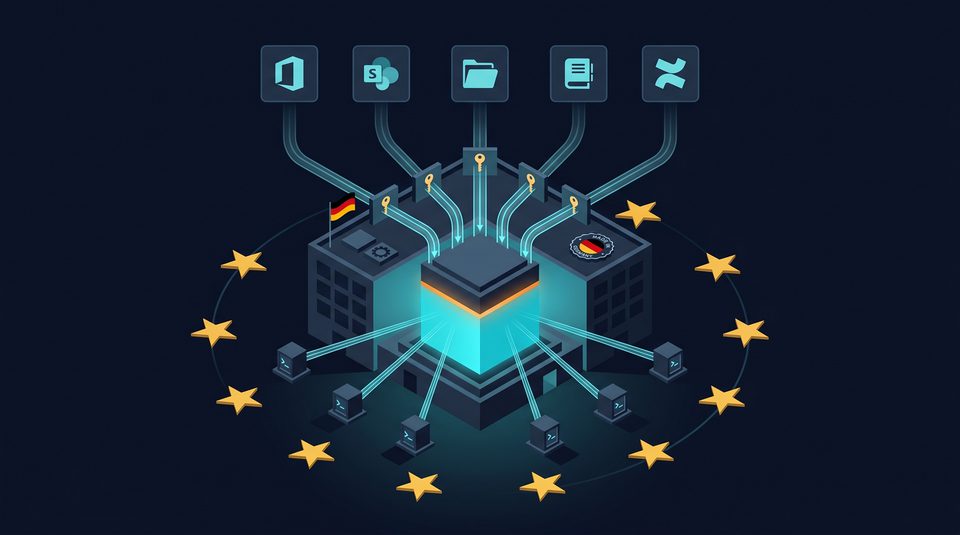
A production-ready system for sovereign AI knowledge management consists of six layers plus a cross-cutting audit trail.
The six layers at a glance:
- Layer 1, source systems (existing IT): Read access to existing data sources, no data copy required.
- Layer 2, connectors: Microsoft 365, SharePoint, Exchange, Confluence, file servers (NFS/SMB), SQL, Nextcloud, Dozuki, websites, ad-hoc upload.
- Layer 3, identity and permissions: AD/LDAP integration, permission mirroring per source and per document.
- Layer 4, vector database: Embeddings of all indexed content plus permission metadata per document.
- Layer 5, language model (inference core): Open-source LLM (Mistral, Qwen, Gemma) on local GPU hardware, RAG pipeline.
- Layer 6, user front end: Browser interface, chat interface, optional Teams integration.
Cross-cutting audit trail. It logs per query: who asked what and when, which sources were found, which answer was generated. Fully local, with no external telemetry. It satisfies Art. 30 (record of processing activities), EU AI Act Art. 12⁄19 (logging obligations for high-risk systems and general traceability), and NIS2 requirements for traceability.
Sovereignty requirements per layer:
- Layers 1 to 2: Read access to existing systems. No migration, no data copy into third-party systems.
- Layer 3: Existing AD/LDAP structures are mirrored, not replaced.
- Layers 4 to 5: The vector database and language model run on on-premises hardware. No external inference service, no cloud vector database.
- Layer 6: The user front end sits inside the corporate network. No external SaaS component in the query path.
- Audit trail: Fully local, sufficient for the record of processing activities and EU AI Act risk management.
The architecture therefore meets the three core requirements of sovereign AI knowledge management: data stays in house, permissions are enforced, and every use is traceable.
GDPR
The GDPR (General Data Protection Regulation, EU 2016/679) is the European regulation for the protection of personal data — particularly relevant for IT infrastructure in Art. 5 (principles), Art. 17 (right to erasure), Art. 28 (processors) and Art. 32 (security of processing).
GDPR
The GDPR (General Data Protection Regulation, EU 2016/679) is the European regulation for the protection of personal data — particularly relevant for IT infrastructure in Art. 5 (principles), Art. 17 (right to erasure), Art. 28 (processors) and Art. 32 (security of processing).
8. Measuring success and ROI #
An economic assessment of AI knowledge management needs more than the promise of an abstract productivity gain. Four metrics deliver solid evidence:
Time to answer. How long do staff take to find a specific piece of information, before and after introduction? Cutting 15 minutes of research to a 1‑minute AI answer is realistic and measurable for many questions.
Answer quality. How often does an AI answer actually lead to a solution, versus how often does the employee still go and ask a colleague? This rate can be captured through samples or feedback buttons.
Compliance maturity. How many data classes are covered by the official solution? What share of AI use is documented in the record of processing activities? Full coverage is measurable, and it makes shadow AI structurally less attractive.
Decline in shadow AI. Repeated staff surveys (with amnesty) show whether the official solution is actually being adopted or whether shadow AI continues.
A realistic expectation. The St. Louis Fed study (see section 2) measures roughly 5.4% of weekly time saved among regular users of generative AI. For 50 staff at 1,760 annual working hours, that equals about 4,750 hours per year, a substantial value at mid-range hourly rates between 60 and 100 EUR. More important than the exact figure is the insight: the economic effect comes not from the tool, but from consistently connecting your own data and from training your staff. Tools without a data connection generate hype, but no value.
9. 90-day action plan #
Days 1 to 30: lay the groundwork
Define data classes: which data may go into which AI. Run a permission audit for the top three sources (usually SharePoint, file servers, Confluence). Draft an AI policy and update the record of processing activities. Set up AI literacy training in line with EU AI Act Art. 4.
Days 31 to 60: build the pilot
Evaluate a managed appliance or start a proof of concept. Identify a pilot group (typically one team with a clear knowledge need, such as contract management, compliance, or service operations). Connect tier 1 connectors (Microsoft 365, SharePoint). Run real use cases through the first queries. Gather feedback.
Days 61 to 90: scale
Connect tier 2 and tier 3 connectors (Confluence, file servers). Bring in a second user group. Set up audit trail analysis. Run a first permission-drift analysis. Communicate to all staff: which solution is available for which data classes, what remains prohibited, and why the official solution is genuinely useful.
After 90 days: Productive operation with continuous expansion of sources, user groups, and use cases
10. Frequently asked questions
Cloud AI services make sense for non-critical content and general tasks. For AI knowledge management in the narrow sense, work on sensitive, confidential, or regulated data, they have two structural weaknesses. First, they make over-broad permissions effective at once: a poorly configured document store becomes a data source for everyone. Second, processing happens outside the organization, which is not permitted for regulated data.
Technically yes, the open-source building blocks are available. In practice, most DIY projects fail on connectors, access control, and maintenance. A proof of concept is feasible; productive operation with compliance requirements needs a permanent team.
AI knowledge management inference needs a professional GPU with sufficient memory; the requirement depends on the model and the number of users. A managed appliance ships the hardware in the right configuration. If you go DIY, plan for at least one GPU of the current server generation.
For most enterprise scenarios, open-source models such as Mistral, Qwen, or Gemma are powerful enough and well manageable in terms of meaning. The important thing is that the model stays interchangeable: the field moves fast, and committing to a single model is risky.
RAG markedly reduces hallucinations because the model draws on specific sources. But they are not ruled out. A good system makes this transparent: source citations on every answer, flagging of answers without a sufficient source basis, and clear signals to the user.
In the RAG model this is simple: remove the document from the source and reindexing runs. On the next query, the document is gone from the result set. With a model trained on the data, this would be much harder.
Three cost blocks: hardware (one-off, depending on vendor and configuration), licenses (typically in packages per user), and maintenance (annual). With a managed appliance the total cost of ownership is predictable: no usage-based token costs, no cloud bill. Specific terms via the sales team.