Data sovereignty without compromise
Protect production data, reduce archiving costs, make internal data usable
Rising archive costs on the one hand, and ransomware attacks on production networks on the other. Add to that the pressure to use AI with internal, sensitive data. All of these issues can be resolved — with on-premises infrastructure that has neither cloud dependencies nor software vulnerabilities.
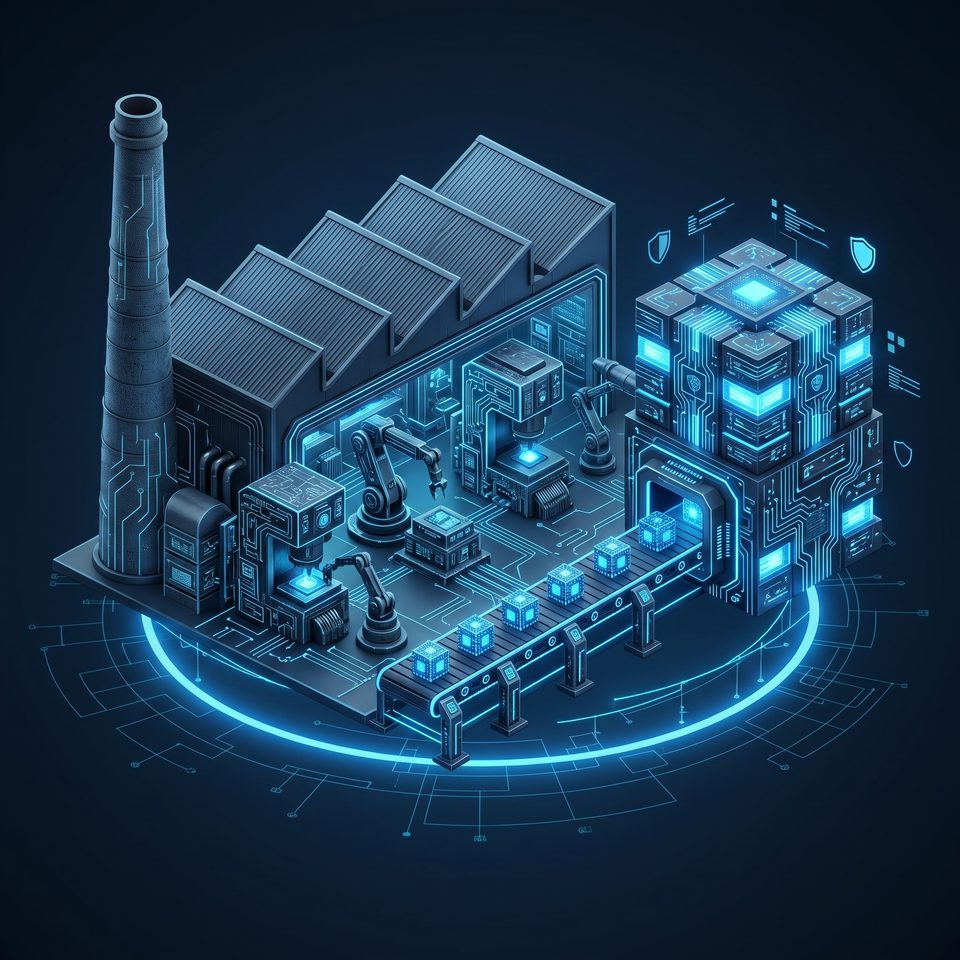
The double risk in production IT #
Industrial companies sit between two grindstones. Archive data volumes grow every year (documents, manufacturing records, test protocols, ERP output), and the cost of keeping them grows with them. At the same time, the threat picture of recent years shows what a ransomware attack on a production network can do: production standstill, delivery delays, recovery costs in the millions, and, where backups hung in the same logical network as the infected systems, total data loss.
According to the Sophos State of 2024, 56% of organizations whose data was encrypted paid a ransom, and attackers often stay undetected in the network for weeks. Both problems share one root: too much dependence on infrastructure you do not fully control. Archives that cost too much because every gigabyte sits on a license-dependent system. Too little backup protection because the separation between the production network and the backup target exists only on paper.
Ransomware
Ransomware is malware that encrypts data on infected systems and demands a ransom for decryption — with the goal of forcing organizations and public bodies to pay by paralyzing their operations.
Referenz: manroland Goss web systems. 90% reduction in costs in the SAP archive.
manroland Goss web systems GmbH is one of the world's leading manufacturers of sheet-fed offset printing presses. The company runs a grown SAP landscape with extensive archive data: documents, postings, and manufacturing records that have to be kept for up to ten years under national tax and commercial law.
The problem: The running cost of the existing SAP archive scaled linearly with the data volume. Every additional terabyte meant more license cost, more operating effort, and more dependence on a system that was not built for these data volumes.
The solution: A switch to Silent Cubes as the SAP archiving platform, fully integrated over SAP ArchiveLink and ILM (Information Lifecycle Management).
The result: A 90% reduction in SAP archive costs, with full compliance, gap-free SAP integration, and an unchanged experience for all SAP users.
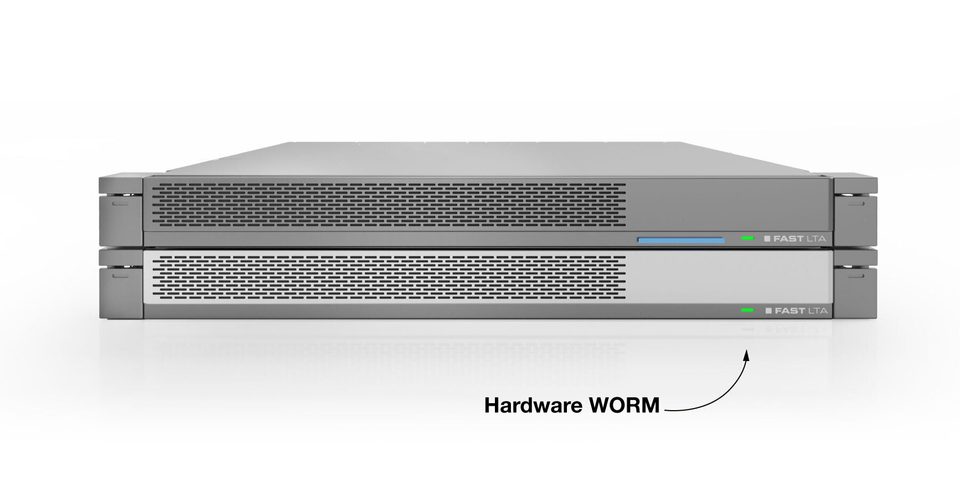
The hardware- function of the Silent Cubes ensures that archived SAP documents meet the immutability requirement, not through a software lock that an administrator could disable, but through a hardware controller that no software can overwrite.
WORM
WORM (Write Once, Read Many) refers to a storage principle in which data is written once and can technically no longer be altered or deleted — in hardware WORM, this immutability is a physical property of the storage controller, independent of software, operating system or user privileges.

Silent Cubes: compliant archiving, without the license trap
Silent Cubes were built for exactly this requirement: long-term retention of large document volumes, tamper-proof, cost-efficient, fully under your own control. Incoming documents, manufacturing records, ERP output, and quality documents are stored once and stay immutable, without every additional terabyte triggering more license cost.
Technical highlights:
- Broad connectivity: standard interfaces for ERP, DMS, and archiving systems; native SAP ArchiveLink / ILM integration available for SAP environments (see the manroland reference)
- OpenDocument format: an open storage format with no proprietary dependencies, guaranteeing long-term availability
- Configurable retention periods: up to ten years for tax-relevant material, individually adjustable for other document classes
- Hardware : immutability through the hardware controller, not a software lock
Compliance:
- National tax and commercial law (in Germany: , HGB §§ 238, 257, AO § 147): immutability, completeness, and traceability of business and tax records, typically up to 10 years; physically secured
- EU VAT Directive (2006/112/EC): invoice retention as required by national implementation
- ISO/IEC 27001: integrity of archived data as a documented protection objective
Operation is fully on premises: no cloud, no third-party license dependency, no monthly storage cost that grows with the data volume. A one-time hardware investment that is low-maintenance, scalable, and auditable.
WORM
WORM (Write Once, Read Many) refers to a storage principle in which data is written once and can technically no longer be altered or deleted — in hardware WORM, this immutability is a physical property of the storage controller, independent of software, operating system or user privileges.
GoBD
The GoBD (Principles for the Proper Management and Storage of Books, Records and Documents in Electronic Form as well as Data Access) is a German Federal Ministry of Finance letter that specifies how tax-relevant documents must be archived electronically in Germany — particularly regarding immutability, completeness and auditability.
Silent Brick System: ransomware resilience for OT/IT convergence
Production networks and IT networks are converging. PLC systems, SCADA controllers, and manufacturing equipment are now reachable over the same network as ERP systems and Windows clients. That widens the attack surface considerably and turns ransomware into a risk that is no longer confined to the office.
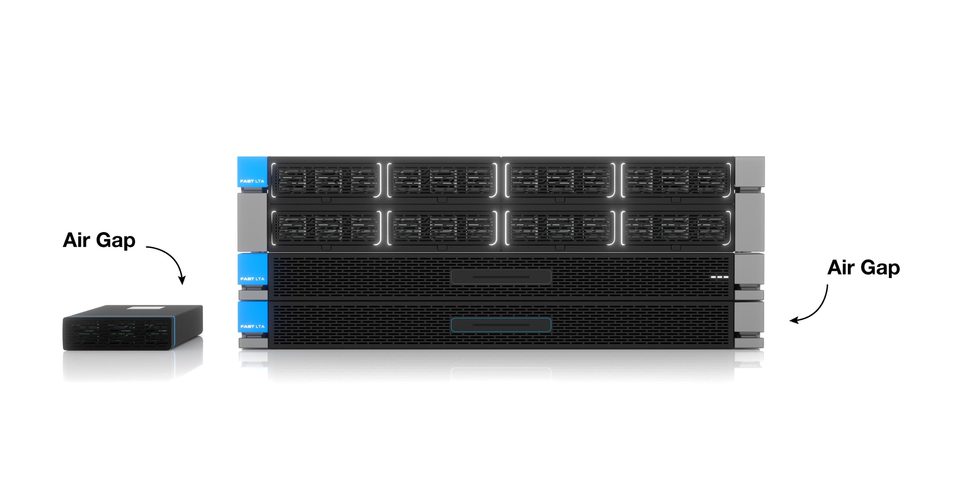
The Silent Brick System protects backup data with a physical air gap: the Silent Brick Max Air severs the network connection at the hardware level as soon as the backup job completes. During the separation phase, the device is unreachable for any system on the network, whether a backup server or an attacker moving in the same segment.
For industrial environments this means:
- Backup data from production systems (MES, SCADA, ERP) is physically isolated; no attack on the OT network can reach it
- Suitability for essential-entity environments under eases the documentation toward supervisory authorities
- Compatibility with Veeam, Commvault, and Acronis; no change of backup software required
- Fast recovery of production data after an incident, because the backup copy stayed intact
NIS2
The NIS2 Directive (EU 2022/2555) is an EU regulation that obliges essential and important entities to implement specific cybersecurity measures — including demonstrable backup management, crisis management and reporting obligations — with personal liability for management bodies in case of non-compliance.
Silent AI: make technical documentation available internally
Maintenance manuals, quality documents, test protocols, DIN/ISO standards, CAD documentation: industrial companies accumulate technical documentation on a scale that manual search can no longer handle. At the same time, the regulatory demand for documentation evidence grows: REACH, ISO certifications, product liability, quality management under IATF 16949 (automotive) or ISO 9001.
Silent AI combines on-premises AI analysis with existing document stores. Through 15+ connectors, including SharePoint, DMS, and ERP systems, internal knowledge sources are brought together. Maintenance teams can ask technical questions in natural language and get the relevant passages from manuals, wiring diagrams, or test reports immediately, with no cloud transfer, no data-protection risk, and no confidential manufacturing records leaving the network.
Compliance at a glance #
| Regulation | Requirement | FAST LTA solution |
|---|---|---|
| National tax & commercial law (e.g. Germany GoBD, HGB, AO) | Immutability, completeness, traceability of tax-relevant documents; typically up to 10 years | Silent Cubes hardware WORM; standard interfaces to ERP and DMS; full audit trail |
| EU VAT Directive (2006/112/EC) | Invoice retention as set by national implementation | Hardware WORM with configurable, law-compliant retention periods |
| ISO/IEC 27001 | Protect the integrity of information; documentation as a protection objective | Hardware immutability; air-gap backup documentable as a technical measure |
| NIS2 Directive (EU 2022⁄2555) | ICT-security requirements for industry; medium-entity threshold from 50 staff or EUR 10m turnover | Silent Brick Max Air: physical air gap, ISO 27001, suitable for essential-entity environments |
Frequently asked questions
Silent Cubes offer broad connectivity over standard interfaces. Common ERP, DMS, and archive systems can be connected directly. For SAP environments, native integration over SAP ArchiveLink and ILM is available, as implemented in the manroland Sheetfed case. No middleware is required in any case. Existing archive data from proprietary legacy systems (for example OpenText or EMC Documentum) can be migrated; FAST LTA supports this process on a project basis.
Yes. The Silent Brick System works as a backup target in the IT network and requires no direct integration into the OT network. The OT data to be protected is captured through standard backup software (Veeam, Commvault) and written to the Silent Brick System. The physical air gap of the Silent Brick Max Air ensures the backup target is fully separated from the network after the job, even if the OT and IT networks share the same logical segment. For especially strict segmentation requirements (for example under IEC 62443), our specialists advise individually.
Because Silent Cubes store documents in the open OpenDocument format, there is no dependency on the original source system. Archived documents stay readable after a system replacement or migration, with standard tools and no proprietary dependencies. That is a decisive advantage over archive solutions where a system change endangers the readability of the archive.
applies to industrial companies from 50 employees or more than EUR 10 million in annual turnover in certain sectors, including manufacturing (automotive, mechanical engineering, chemicals), energy, and water. Affected companies must demonstrate technical measures to ensure , which explicitly includes backup systems. A physical air gap at the hardware level is the strongest available technical means for this evidence. FAST LTA supports documentation processes on request.
Business Continuity Management
Business Continuity Management (BCM) is the organizational framework that ensures critical business processes can be maintained or restored within defined timeframes even during severe IT failures, cyber attacks or other crises.
NIS2
The NIS2 Directive (EU 2022/2555) is an EU regulation that obliges essential and important entities to implement specific cybersecurity measures — including demonstrable backup management, crisis management and reporting obligations — with personal liability for management bodies in case of non-compliance.
NIS2
The NIS2 Directive (EU 2022/2555) is an EU regulation that obliges essential and important entities to implement specific cybersecurity measures — including demonstrable backup management, crisis management and reporting obligations — with personal liability for management bodies in case of non-compliance.
We’d be happy to advise you
Over 2,500 companies and public institutions in Germany rely on FAST LTA — including numerous DAX-listed companies. Developed and manufactured in Munich. Personal advice from FAST LTA engineers — not a sales call, but a technical consultation backed by industry experience.

Account Executive Enterprise