Silent AI • Making use of internal knowledge • Made in Europe
Local AI knowledge management, which respects your permissions and never shares your data with cloud providers.
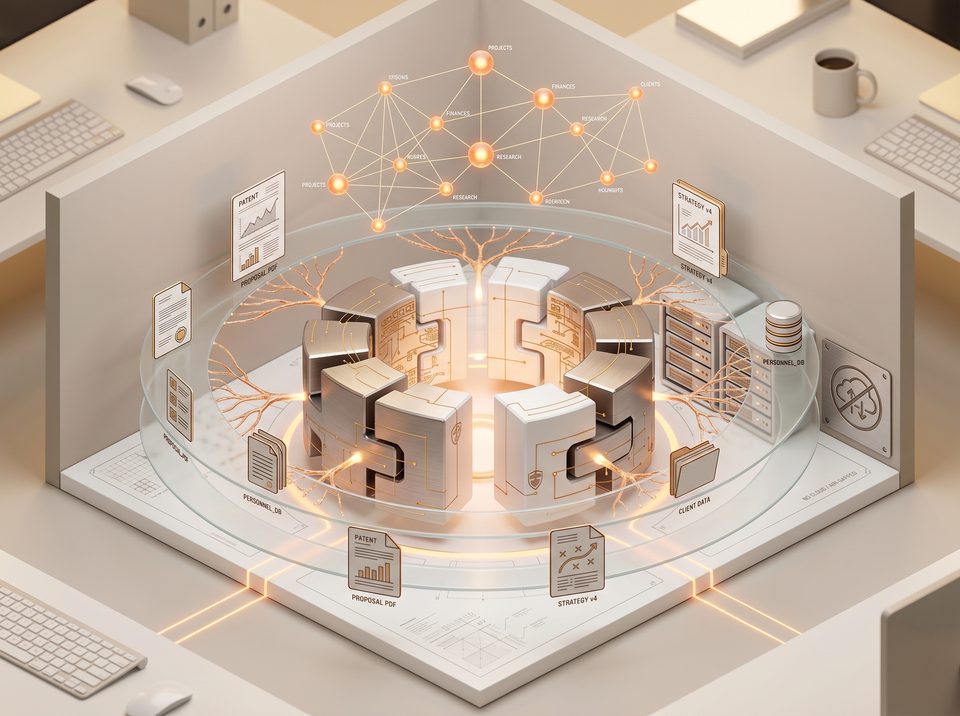
Silent AI makes corporate knowledge usable without prompts, documents or responses ever leaving the network. Existing IdP and application permissions are fully enforced: no one receives an AI response based on content they do not have permission to view.
The Problem
Shadow AI is already a threat. And cloud AI isn't suitable for every dataset.
Generative AI has spread more quickly within German companies than rules, guidelines and approval processes. 25% of companies with 20 or more employees report active use of tools in their day-to-day work — and the trend is rising (Bitkom AI Study 2025). At the same time, US hyperscalers dominate the market: Copilot, ChatGPT and Gemini together account for over two-thirds of the AI tools used by businesses.
For non-critical tasks such as translations, summaries, and image and video editing, this is often not a problem. For sensitive data, it is.
What specifically concerns compliance and IT managers:
On-Premises AI
On-premises AI refers to AI systems operated entirely on an organization's own hardware in its own data center or server room — without cloud connectivity, without data transfer to external services.
Employees often have no alternative. If the official IT department does not provide verified AI, staff resort to using personal accounts. Draft contracts end up in ChatGPT, patient data in Copilot, and design data in Gemini. A ban alone will not solve the problem.
Prompts and responses reveal more than a browser history. A single query to a cloud-based AI can reveal more about ongoing projects, strategies and internal structures than months of monitoring internet traffic. The prompt provides context; the response reflects how the system has interpreted it.
AI services necessitate a new approach to access management. Most cloud services, as well as many on-premises appliances, require that the Active Directory access management system successfully implemented within the company be set up in parallel. This is time-consuming, prone to errors and creates a second source of access rights that diverges from the actual situation.
The , and the are creating a need for action. The has been in force since August 2024, and will become mandatory in Germany at the end of 2025. Under the and FISA Section 702, US authorities are permitted to request data from US companies worldwide, regardless of the location of the servers.
US CLOUD Act
The US CLOUD Act (Clarifying Lawful Overseas Use of Data Act, 2018) authorizes US authorities to require US companies to hand over data — regardless of where that data is physically stored, including servers located in the EU.
EU AI Act
The EU AI Act is the world's first comprehensive legislative regulation of AI systems, in force since August 2024. It classifies AI applications by risk level and sets concrete requirements for transparency, control, data protection and human oversight for high-risk systems.
EU AI Act
The EU AI Act is the world's first comprehensive legislative regulation of AI systems, in force since August 2024. It classifies AI applications by risk level and sets concrete requirements for transparency, control, data protection and human oversight for high-risk systems.
US CLOUD Act
The US CLOUD Act (Clarifying Lawful Overseas Use of Data Act, 2018) authorizes US authorities to require US companies to hand over data — regardless of where that data is physically stored, including servers located in the EU.
US CLOUD Act
The US CLOUD Act (Clarifying Lawful Overseas Use of Data Act, 2018) authorizes US authorities to require US companies to hand over data — regardless of where that data is physically stored, including servers located in the EU.
NIS2
The NIS2 Directive (EU 2022/2555) is an EU regulation that obliges essential and important entities to implement specific cybersecurity measures — including demonstrable backup management, crisis management and reporting obligations — with personal liability for management bodies in case of non-compliance.
NIS2
The NIS2 Directive (EU 2022/2555) is an EU regulation that obliges essential and important entities to implement specific cybersecurity measures — including demonstrable backup management, crisis management and reporting obligations — with personal liability for management bodies in case of non-compliance.
The solution
Silent AI as a local AI appliance. Kein Cloud-Ersatz, sondern die fehlende Alternative.
Silent AI does not replace cloud-based AI. For general tasks, translations, and image and video editing, ChatGPT, Claude or Gemini are usually the better choice. Silent AI handles what cloud-based AI is structurally unable to do: AI-powered knowledge work involving sensitive, confidential or regulated corporate data. Entirely on-premises, using existing permissions.
What Silent AI does for sensitive data:
Zero Cloud by Design.
All data remains on the local appliance. No prompts, no vectors, no tokens leave the network. There is no cloud fallback that offloads data during peak loads.
Active Directory permissions are fully enforced.
Silent AI integrates with the existing Active Directory or LDAP. AI responses are based exclusively on documents to which the user making the request has read access. An incorrectly configured SharePoint site will not suddenly become a source of information for anyone who asks for it.
RAG, not hallucination.
Silent AI uses on internal data: answers are compiled from actual documents, with source attribution. The LLM does not make up paragraphs, contract clauses or study results.
RAG (Retrieval-Augmented Generation)
RAG is an AI architecture in which a language model does not answer from memory but retrieves answers from a defined, controlled dataset and generates responses on that basis — structurally eliminating hallucinations.
Predictable TCO, no token-based billing.
A one-off investment in hardware and licences. No usage-based cloud costs, no unexpected price increases. CARE maintenance contracts guarantee support and updates for up to 10 years on fixed terms.
Compliance-ready.
-compliant, NIS 2-compliant, -compliant. No transfer of personal data to third countries. Structurally, no US Cloud Act risk.
EU AI Act
The EU AI Act is the world's first comprehensive legislative regulation of AI systems, in force since August 2024. It classifies AI applications by risk level and sets concrete requirements for transparency, control, data protection and human oversight for high-risk systems.
GDPR
The GDPR (General Data Protection Regulation, EU 2016/679) is the European regulation for the protection of personal data — particularly relevant for IT infrastructure in Art. 5 (principles), Art. 17 (right to erasure), Art. 28 (processors) and Art. 32 (security of processing).
Made in Europe.
Development, sales, support and manufacturing in Germany. Largely local supply chains, short lead times.
From the data source to a definitive answer
Entirely local. Entirely under your control. No cloud connection during operation.
Source systems
Connectors
Vectorisation
RAG engine
LLM (Mistral)
Silent AI. 100% local. 100% secure. 100% yours.
Silent AI is a turnkey appliance designed to make data from various sources and applications searchable and usable locally, without the need for a cloud connection. Silent AI is ideal for regulated industries or users who are unable or unwilling to send data, prompts or responses to a cloud-based AI system.
Comparison
Three approaches to local AI. Why only one person is standing up for small and medium-sized businesses.
The options differ significantly in terms of cost, maintenance and future-proofing.
Train your own LLM
A language model developed entirely in-house on our own infrastructure
+ Maximum specialisation and control
– Costs running into millions of euros
– Requires an in-house ML team
– Models become outdated quickly
– Rollout: takes months or even years
For: Large corporations conducting AI research
Managed Appliance
Silent AI: ready-to-use hardware with on-device inference, professional RAG, AD integration and support
+ Deployment in days
+ Full compliance with AD permissions
+ Interchangeable LLM, no vendor lock-in
+ 15+ connectors included as standard
+ CARE maintenance for up to 10 years
– Higher initial investment than a DIY solution
Silent AI — FAST LTA, Made in Europe
RECOMMENDED FOR SMALL AND MEDIUM-SIZED ENTERPRISES, PUBLIC SECTOR BODIES & REGULATED INDUSTRIES
DIY with local LLMs
Ollama, LM Studio, llama.cpp on a dedicated GPU; custom-built RAG pipeline
+ Low barrier to entry
+ Full flexibility for developers
– No rights management out of the box
– No SLA, no support
– M365 integration: must be built in-house
– High maintenance costs in production
For: Individual users, prototyping
Regulatory framework
Compliance: What Silent AI covers
The technical basis for the key regulatory requirements in German companies.
| Regulation | Requirement | Silent AI |
|---|---|---|
| GDPR Art. 5, 25, 32 | No transfer without a legal basis; technical and organisational measures | ☑ |
| GDPR Art. 44 ff. | No unjustified transfer to third countries | ☑ |
| EU AI Act | Transparency, verifiability, risk management, AI competence (Art. 4 from February 2025) | ☑ |
| NIS2 / KRITIS | Security of critical IT systems, risk assessment of AI | ☑ |
| DORA | ICT risk management, third-party risks in the financial sector | ☑ |
| BIS-Grundschutz | Requirements for secure IT systems | ☑ |
| US CLOUD Act / FISA 702 | Excluded: no US service in the operational path | ☑ |
Silent AI provides the technical foundation. Full compliance also requires organisational measures (AI policy, record of processing activities, risk analysis in accordance with the EU AI Act). FAST LTA provides support with implementation.
In which sectors is Silent AI particularly relevant?
In any situation where sensitive data must not be processed using cloud-based AI.
Frequently asked questions
No. For general tasks — such as translations, summaries, and image and video editing — cloud-based AI solutions are usually the better choice. Silent AI covers the areas that cloud-based AI is structurally unable to handle: AI processing of sensitive, confidential or regulated data, with full data control and strict adherence to access permissions.
By default, a current open-source model (currently Mistral). The model is decoupled from the data architecture and interchangeable — Qwen, Gemma and other models are available. No lock-in to a single provider.
Licences are issued in packages of 25, 50 or 100 named users. There is no fixed performance limit at the hardware level; the actual response time depends on the query profile, the chosen LLM and the configuration. The actual load is measured for the customer during the trial period.
A standard rollout (hardware, M365 + SharePoint + file server connectors, ID provider/IAM integration) takes a few days. More complex environments are set up in a trial phase — typically taking 2 to 4 weeks.
Yes. Silent AI is not a system of restrictions, but rather a complementary tool. It makes sense to have a clear policy: which AI is authorised for which data categories. FAST LTA provides a template for this.
Next step
You can’t solve the problem of shadow AI with bans. But with a safe alternative.
Silent AI is the solution for sensitive data: local, with strict access controls, no cloud, and no . Talk to our engineers about your data assets and the right connectors.
US CLOUD Act
The US CLOUD Act (Clarifying Lawful Overseas Use of Data Act, 2018) authorizes US authorities to require US companies to hand over data — regardless of where that data is physically stored, including servers located in the EU.
