Enterprise AI · On-Premises · Made in Germany
Silent AI Pro. AI agents that stay in-house.
An on-premises AI work environment on your own appliance – made in Germany. Hardware, software, and service from a single source. - and -compliant by design. Projects, skills, agents, and artifacts – near zero hallucinations, no cloud, fixed costs.
Overview & Software • Appliance • CARE • TCO calculator
EU AI Act
The EU AI Act is the world's first comprehensive legislative regulation of AI systems, in force since August 2024. It classifies AI applications by risk level and sets concrete requirements for transparency, control, data protection and human oversight for high-risk systems.
GDPR
The GDPR (General Data Protection Regulation, EU 2016/679) is the European regulation for the protection of personal data — particularly relevant for IT infrastructure in Art. 5 (principles), Art. 17 (right to erasure), Art. 28 (processors) and Art. 32 (security of processing).
100% on premises
Data never leaves the premises. No cloud risks, no transfers to third countries.
No token limits
Fixed costs, full predictability. No pay-as-you-go surprises.
Projects
Work contexts with their own sources, their own scope, reusable.
Agents and Tools
Carry out multi-step tasks, not just answer them. Connects to your line-of-business systems.
Skills
Define recurring tasks once and share them in-house.
Artifacts
Results take shape as a document, an analysis, or a draft, not just a chat reply.<
Memory
Context that carries across sessions, so work continues instead of starting over.
Near zero hallucinations
With RAG enabled, every answer includes a verifiable source reference.
Identity Provider Connection
LDAP/AD, OIDC/SSO (Okta, Entra ID, Google Workspace) or a hybrid solution. Permissions from the IdP and source system are automatically synchronised.
Privacy by design
End-to-end encryption, incognito mode, rights management.
Managed appliance
All-inclusive CARE contract: 1 to 5 years of maintenance and support.
Made in Europe
Appliance from a German manufacturer. Managed with FAST LTA CARE.
Intuitive Chat Interface
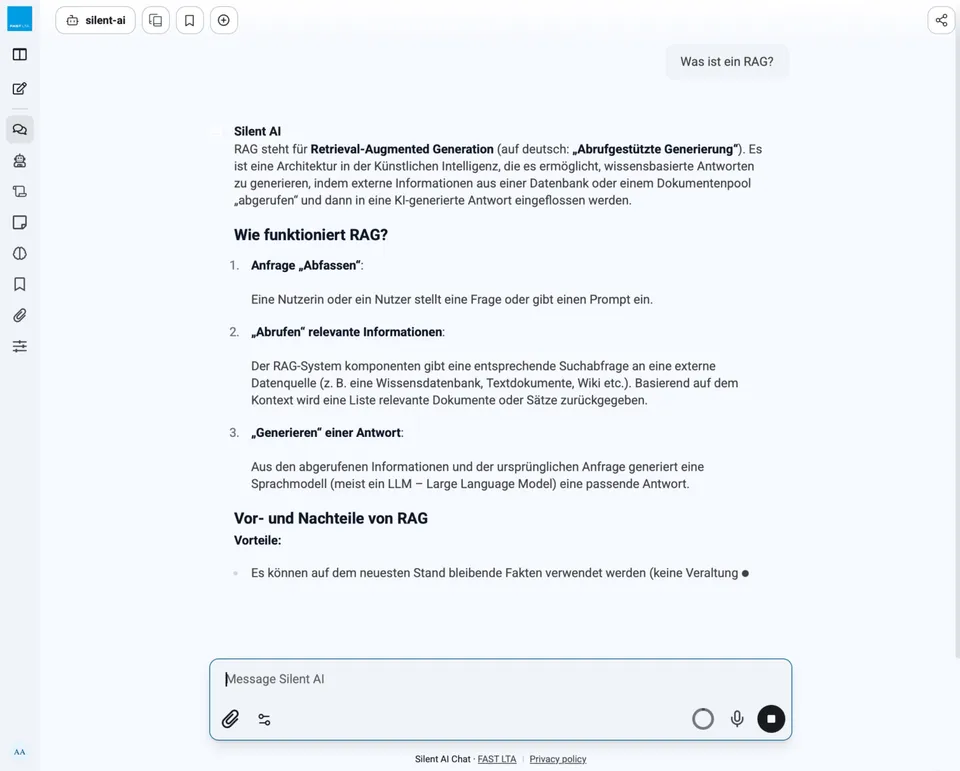
Ask questions, get instant clarity. Silent AI Pro answers questions in natural language – as simple as a conversation. Every answer cites its source and points to the exact location in the original document. If the system finds no basis for an answer, it says so instead of guessing
AI-Agents On-Premises
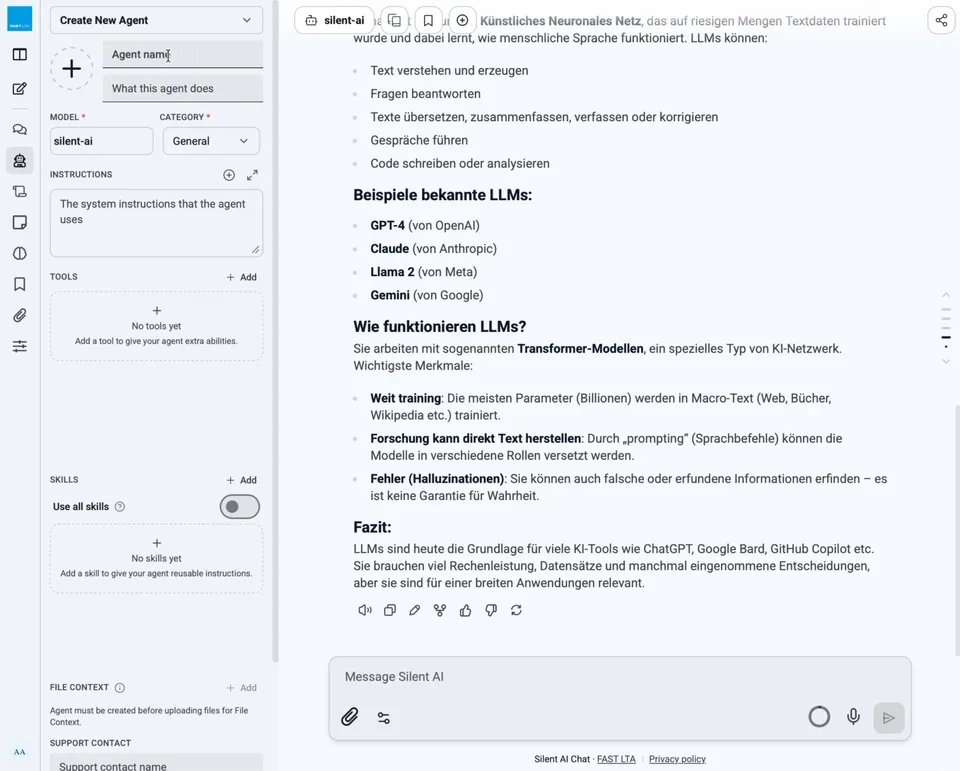
AI agents plan and complete multi-step tasks on their own – entirely on your own appliance. No data or intermediate results ever leave the building. No cloud risk, no third-country data transfer. The same permissions, sources, and citations apply as for any other request.
Connect tools. Get tasks done.
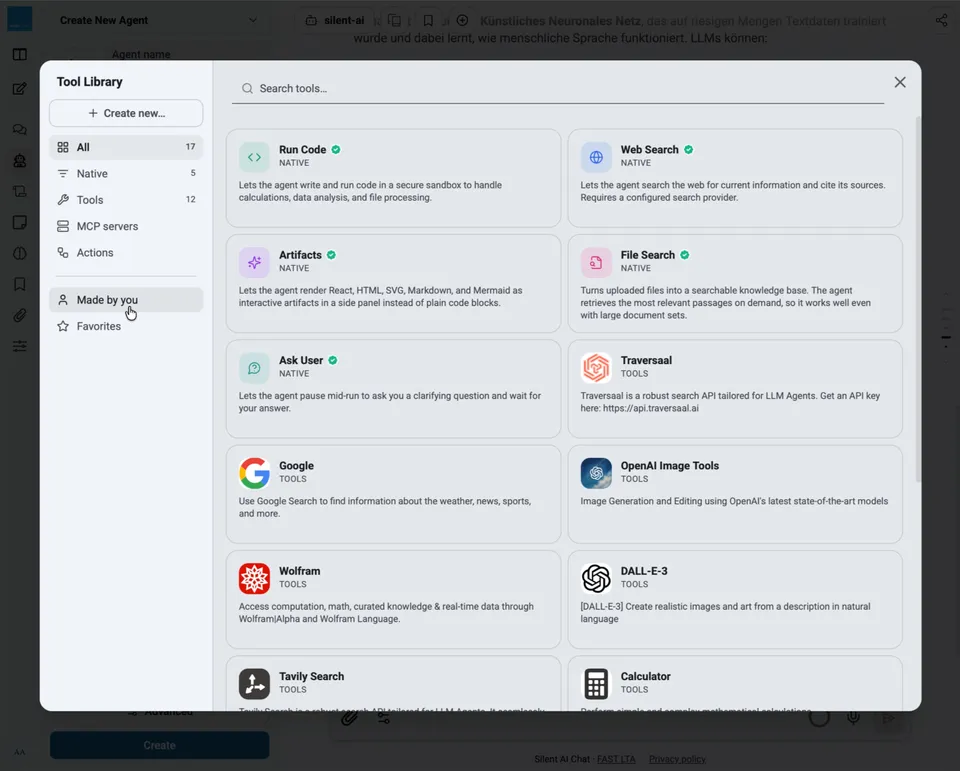
Silent AI Pro connects to your existing business systems and carries out multi-step tasks on its own – not just answering, but getting things done. It plans the steps, checks intermediate results, and accesses the right systems directly when needed – locally, with the same permissions.
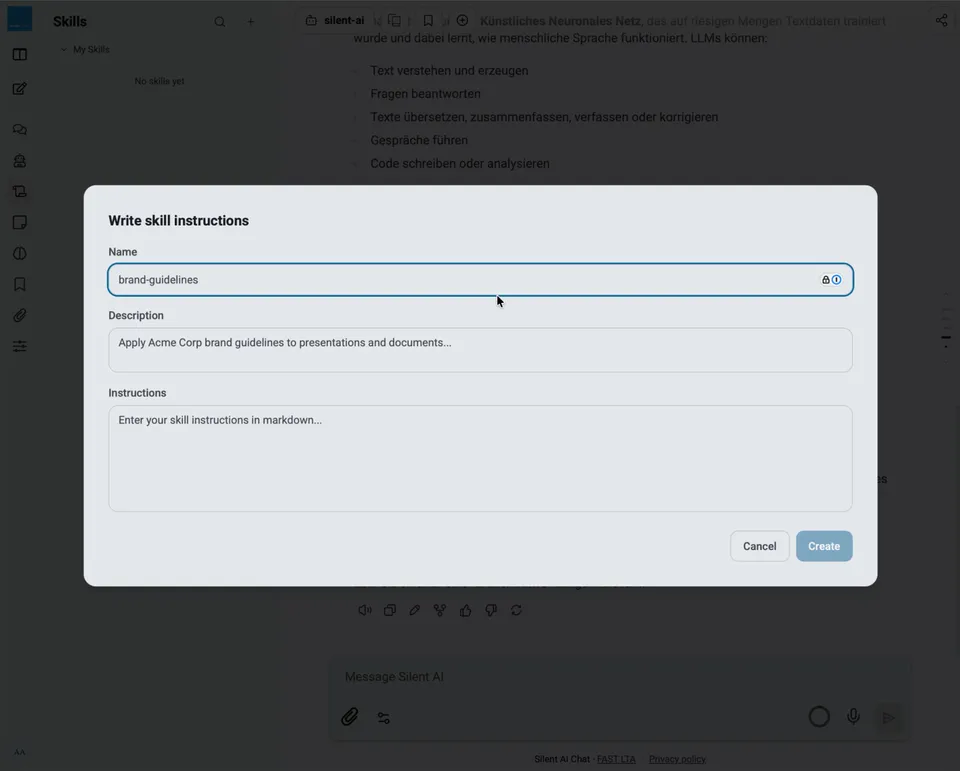
Define Skills once, Reuse Them Anytime
Recurring tasks are described once and are then available again anytime – locally, on your own data. Automatically check contracts against internal guidelines. Prepare service reports in a fixed format. No cloud – directly on your own documents and systems.
Use cases and target groups
Silent AI is particularly well suited to regulated industries and applications involving sensitive data that cannot or should not be stored with public cloud providers. No data, no prompts and no responses ever leave your premises.
Intranet, travel expense policies, holiday regulations, IT guidelines: employees ask questions instead of searching — and get the answer, not ten search results.
Why AI Search or Work Environment
One answer from multiple sources — search Confluence, file servers and SharePoint together instead of clicking through them individually.
Why on-premises
Internal policies and HR content are sensitive enough to warrant a critical assessment of cloud processing.
Target audience
All organisations with extensive knowledge bases — from administration to development.
The hotline and field service teams draw on solutions from historical tickets, maintenance reports and knowledge bases — with a direct link to the source system.
Why AI Search or Work Environment
Service knowledge is scattered and written in inconsistent language — yet Silent AI delivers the right solution in seconds.
Why on-premises
Tickets contain customer data and contract details — -compliant and confidence-building in B2B.
Target audience
Mechanical engineering firms, IT service providers, medical technology companies and all service organisations.
GDPR
The GDPR (General Data Protection Regulation, EU 2016/679) is the European regulation for the protection of personal data — particularly relevant for IT infrastructure in Art. 5 (principles), Art. 17 (right to erasure), Art. 28 (processors) and Art. 32 (security of processing).
Legal departments can find clauses, case law and framework agreements in seconds — using semantic search rather than laboriously scrolling through SharePoint structures.
Why AI Search or Work Environment
Lawyers look for contextual meaning, not keywords. Every result comes with a source — due diligence included.
Why on-premises
Client confidentiality and the protection of trade secrets structurally preclude cloud solutions.
Target audience
Legal departments, law firms, M&A teams, procurement in regulated industries.
Administrative staff can search through files, cases and precedents in minutes rather than hours — with a traceable source for every statement.
Why AI Search or Work Environment
Administrative language is inconsistent — Silent AI identifies connections between cases that would otherwise remain hidden.
Why on-premises
Often mandatory under public procurement law, politically desirable — German sovereignty as a genuine selling point.
Target audience
Federal, state and local government, public enterprises, social security providers.
R&D teams make scattered research reports, patent applications and test records searchable together — using concepts, not keywords.
Why AI Search or Work Environment
Research thrives on synonyms and concepts — Silent AI finds content that a keyword search would never uncover.
Why on-premises
Intellectual property must not leave the appliance. The cloud is structurally unsuitable for this purpose.
Target audience
Pharmaceuticals, medical technology, chemicals, mechanical engineering innovation, IP-driven hidden champions.
Auditors and compliance officers provide evidence with a complete chain of evidence — the source reference also serves as an audit trail.
Why AI Search or Work Environment
Every answer comes with the source — the audit trail is created during the search, not afterwards.
Why on-premises
In many cases, the , and industry-specific regulations do not permit cloud processing.
Target audience
Compliance officers, internal audit, data protection, and ISO- and KRITIS-certified organisations.
GDPR
The GDPR (General Data Protection Regulation, EU 2016/679) is the European regulation for the protection of personal data — particularly relevant for IT infrastructure in Art. 5 (principles), Art. 17 (right to erasure), Art. 28 (processors) and Art. 32 (security of processing).
NIS2
The NIS2 Directive (EU 2022/2555) is an EU regulation that obliges essential and important entities to implement specific cybersecurity measures — including demonstrable backup management, crisis management and reporting obligations — with personal liability for management bodies in case of non-compliance.
Software architecture
From the source system to the response: everything is local, everything is traceable.
The data remains local.
The language model is decoupled from the data architecture and can be swapped out (Mistral, Qwen, Gemma, etc.). No data leaves the appliance. Every response includes source references and citations, with hyperlinks to the original documents.
Source systems
Connectors
Vectorisation
RAG engine
Connectors
You can connect your data sources directly using a wide range of available connectors. The existing permissions structure is fully retained in the process.
Further connectors are currently in development / available on request.



Highlight: Identity Management
Data protection isn’t a feature – it’s the architecture
Silent AI takes existing permissions into account when accessing information from connected source systems. We adopt the permissions structure from your ID provider / IAM, such as LDAP/AD, OIDC/SSO (Okta, Entra ID, Google Workspace) or a hybrid solution. Changes are synchronised automatically.
Rights from source systems
SMB, SharePoint, Exchange, …: Permissions are automatically inherited. No manual maintenance, no shadow AI.
Automatic synchronisation
Changes to permissions in the source system are automatically applied. No drift, no risk.
Admin ≠ Read access
Administrators can manage the system but cannot view user requests. Privacy by Design.
AD, Entra and other identity providers
Existing roles and permissions determine who is allowed to view what. Logins, logouts and changes to permissions are logged centrally and can be audited. Standard integration, no custom setup required.
The appliance. Hightech made in Europe.
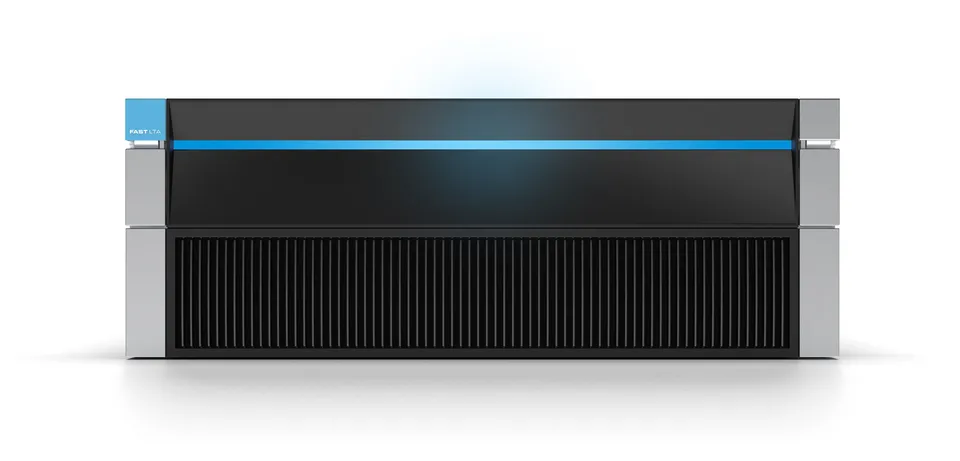
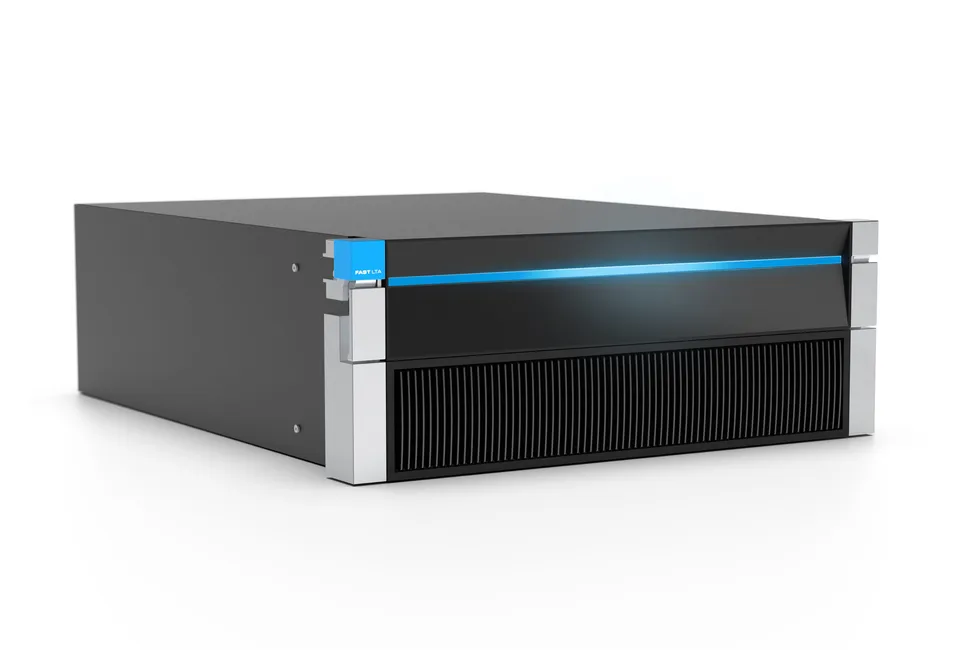
The Silent AI Pro appliance is a fine piece of German engineering. In just 4 rack units (4U), the newly developed hardware platform delivers enough power for agentic, multi-step tasks with multiple concurrent users. Flexibly configurable with up to three Nvidia GPUs, it scales with demand – and can even be upgraded while running, with no need to switch hardware generations. Clean lines and premium metal surfaces give it a minimalist, modern look.
Silent AI and the EU AI Act
The requires organisations that use AI applications in high-risk sectors — including healthcare, critical infrastructure and HR decision-making — to have a documented risk management system in place, as stipulated in Article 9. Silent AI’s on-premises operation significantly simplifies compliance verification: data flows remain controllable within the organisation’s own infrastructure, access can be logged, and there is no need to assess and document the compliance of an external AI service provider.
EU AI Act
The EU AI Act is the world's first comprehensive legislative regulation of AI systems, in force since August 2024. It classifies AI applications by risk level and sets concrete requirements for transparency, control, data protection and human oversight for high-risk systems.
Frequently asked questions
Microsoft Copilot and ChatGPT process queries and — depending on the configuration — the associated documents on cloud servers outside your infrastructure. For organisations that process personal data, client information or government-classified content, this generally raises data protection concerns. Silent AI runs entirely on-premises on your own hardware. There is no cloud connection, no external processing step and no transfer of data to third parties. Furthermore, Silent AI provides source references for every response, ensuring that AI results remain traceable and verifiable — a crucial difference for use in regulated and liability-relevant processes.
Silent AI offers pre-configured connectors for popular workplace applications, including file shares and databases, Microsoft and Google applications such as email, calendars, SharePoint/Drive, knowledge management platforms such as Confluence and Dozuki, and others such as Slack. The connectors enable existing document repositories to be integrated directly into Silent AI without the need for complex data migration. We would be happy to clarify which specific systems in your infrastructure are supported during a technical consultation.
As Silent AI is operated exclusively on-premises and does not transfer any data to external services, it eliminates the key risk associated with cloud-based AI: the processing of data by third parties in accordance with Article 28 and the associated requirements regarding data processing agreements, transfers to third countries and standard contractual clauses. All data remains under your sole control. For a final data protection assessment in your specific operating environment, we recommend consulting your Data Protection Officer.
GDPR
The GDPR (General Data Protection Regulation, EU 2016/679) is the European regulation for the protection of personal data — particularly relevant for IT infrastructure in Art. 5 (principles), Art. 17 (right to erasure), Art. 28 (processors) and Art. 32 (security of processing).
Silent AI is a complete, turnkey appliance with high-performance storage, optimized for AI applications.
Silent AI can be integrated into your IT infrastructure as an appliance via Ethernet. Integration into existing systems is achieved using the supplied connectors, which are preconfigured for common workplace environments. FAST LTA supports the rollout with technical onboarding and ensures that the connection to your data sources works seamlessly. As Silent AI is built on FAST LTA’s proven storage solutions, existing customers benefit from particularly straightforward integration.